
Isostasy


Q. Explain the concept of Isostasy as postulated by Airy and Pratt

Isostasy refers to mechanical stability that exist between all the high lying features like mountains and low lying features like ocean basin on fast rotating earth.

Sir George Airy’s theory
Airy adopted Edward Suess Scheme of earth’s interior structure and assumed that it is made up of three layered structure- Sial,Sima and Nife. Sial is uppermost layer containing crust with density of 2.67 and Sima with density of 3.0.Since, Sima is denser, semi molten and just below sial, sial is floating on sima.
REASON FOR ISOSTASY
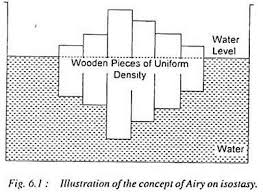
  • Sial can be imagined to be divided into vertical sections containing mountains,plateaus,plain,ocean basin,etc separately..
  • Section with higher feature like mountain has deeper root while section with lower feature has shallow root.Though,same density of all the sections .
  • This arrangement is mechanically stable due to principle of flotation.
  • Airy demonstrated this through an experiment
CRITICISM
  • Iceberg Example: Principle of flotation results in 1:9 ratio of fraction above surface to submerged.In this manner, himalayas would have 81 Km of root.This can’t be the case as at such depth sialic material will melt.
  • Density: Different crustal features like mountains, plateau, plains can’t have similar density.Pratt after survey pointed out that mountains have lesser density than plains.

Archdeacon Pratt Theory
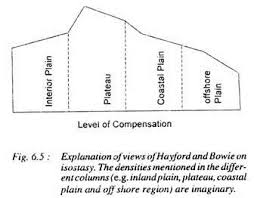
He also used Edward Suess scheme of earth’s interior.His theory differ from Airy as he suggested various crustal features have different densities. This was based on his survey of geological structures of mountains and plains.
According to him density is inversely related to the height of the relief feature. Thus,  mountains would be less denser than plateaus, and plateaus would be less denser than plains.
According to him, no flotation occurs but sima layer exert molecular resistance to sialic layer.There is a line of compensation, where all the crustal features exert same weight. This he demonstrated through an experiment where he used mercury in container and placed in it various metals(different density) with same weight.

CRITICISM
Bowie suggested Pratt’s theory also follow principle of flotation like airy.Also, there is phenomenon of root formation in Pratt’s theory like Airy’s.

Heiskanen Theory
His theory has some element of both Airy’s and Pratt’s theory as well as some of his contribution in such manner that it eliminates most of the limitations of previous theories.
According to him:

  1. Larger the sialic section, deeper is its root.
  2. Larger the section, lesser is the density.
  3. Density increases with depth.

Comments

Popular posts from this blog

DAVIES,PENCK & KING

Geographical Cycle of Davies William Morris Davies was an american geographer who gave first general theory on landform development.. Davis' most influential scientific contribution was the "geographical cycle",  which he defined in an article,’ The Rivers and Valleys of Pennsylvania ,’ published at the end of 19th century. According to him, uplifted landmass undergoes sequential development or erosion till base level in various stages.This sequential development referred as cycle of erosion. FUNDAMENTAL PRINCIPLES 1.Cyclic nature of landform evolution. 2 Uniformitarianism:The same physical processes and laws that operate today, operated throughout geologic time, although not necessarily always with the same intensity as now BASIC POSTULATES Upliftment takes place on featureless plain which he modified 10 yrs later to accept it can occur from geosyncline. Upliftment on geological timescale is sudden.In later works, he accepted it to be episodic. ...

Rene Descartes: A Critique

Introduction René Descartes (1596-1650) was a French philosopher, mathematician, and scientist who is considered one of the founders of modern Western philosophy. He is known for his contributions to analytic geometry, his development of the scientific method, and his famous philosophical statement "Cogito, ergo sum" ("I think, therefore I am"). Descartes is also known for his works on metaphysics, epistemology, and the philosophy of mind. Descartes' ideas had a significant impact on the development of Western philosophy and science. His emphasis on reason and mathematical reasoning as a tool for discovering truth has been influential in the development of the scientific method. Additionally, his ideas on the separation of mind and body and the nature of reality have continued to be influential in modern philosophy. Descartes' works include "Meditations on First Philosophy," "Discourse on the Method," and "Principles of P...

Diving into the Depths of the Unconscious: A Comprehensive Exploration of Carl Jung's Red Book

Carl Gustav Jung's Red Book: Liber Novus is not just a book; it's an experience.  A sprawling, intensely personal, and visually stunning journey into the depths of Jung's psyche, it documents his confrontation with the unconscious and his exploration of the symbolic language of dreams and visions.  Far from a dry academic treatise, it's a vibrant tapestry of text and image, a testament to the power of the unconscious and its profound influence on the individual and collective human experience.  This exploration delves into the Red Book's genesis, its core themes, its unique format, and its lasting impact on our understanding of the self. The Genesis of the Red Book: A Descent into the Unconscious The Red Book's story begins in 1913, a period of intense personal and professional upheaval for Jung.  His break with Sigmund Freud, the founder of psychoanalysis, had left him feeling isolated and disoriented.  Haunted by vivid dreams and visions, Jung embarked on a jo...