
Settlement Geography: Primate City

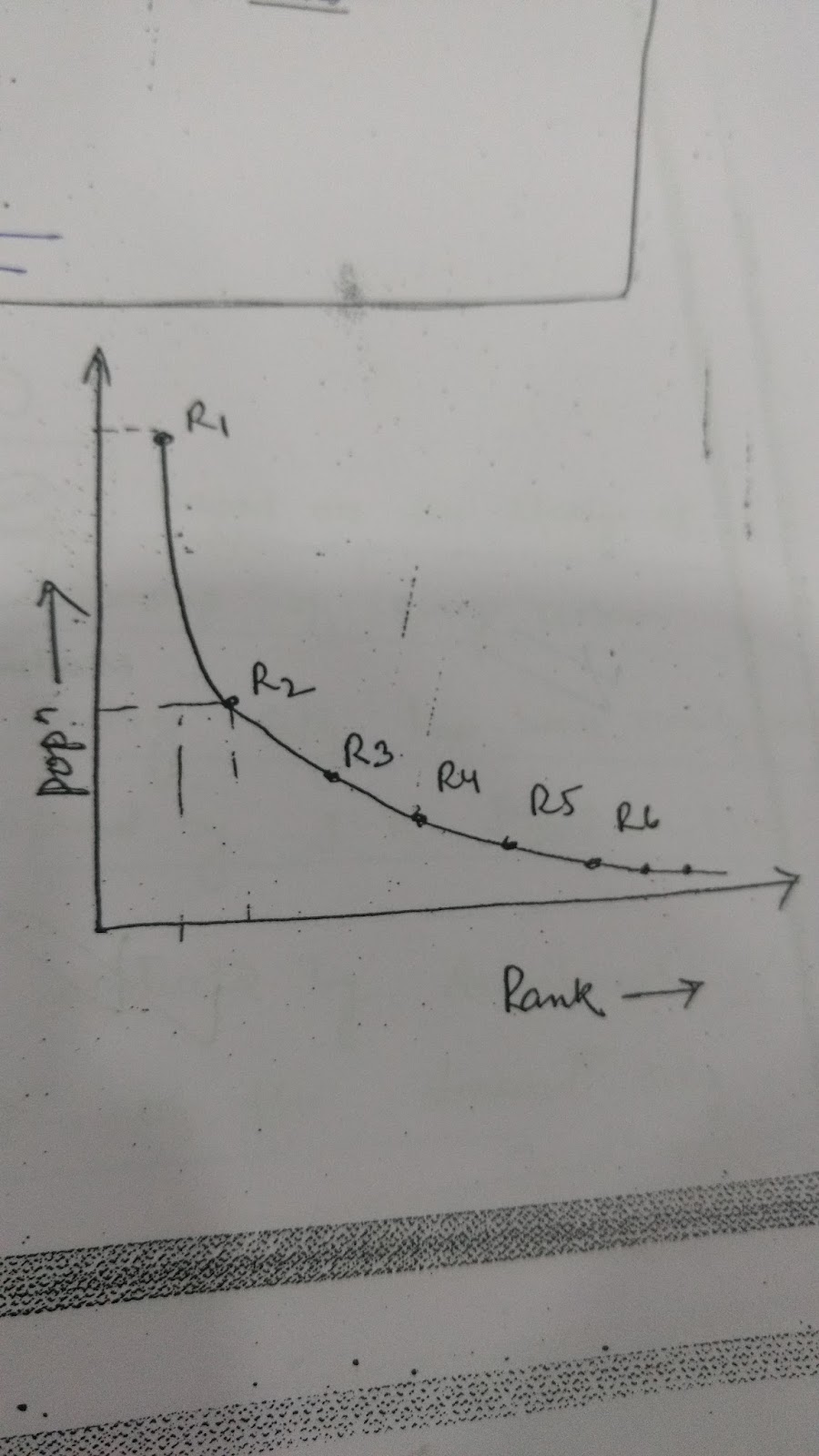
Concept of primate city was given by Mark Jefferson in 1939.Primate city  refers to largest city in a country or a region which is disproportionately larger in  population from the second ranked city in that country or the region.

This concept  was based on inductive study done by Jefferson over 51 countries.He compared the population of largest and second rated cities and made following observations:
For 27 countries: P1/P2 > 2
For 18 countries: P1/P2 > 3
For 6 countries: P1/P2 > 1.2   ; where :  P1 and P2 are populations of first and second ranked cities.
Thus, in most of the countries he found that 1st ranked city was disproportionately  larger than second ranked city.This he named primate city. Thus, mathematically, it was expressed as:
P1/P2 >= 2
primate_city.jpg


Examples
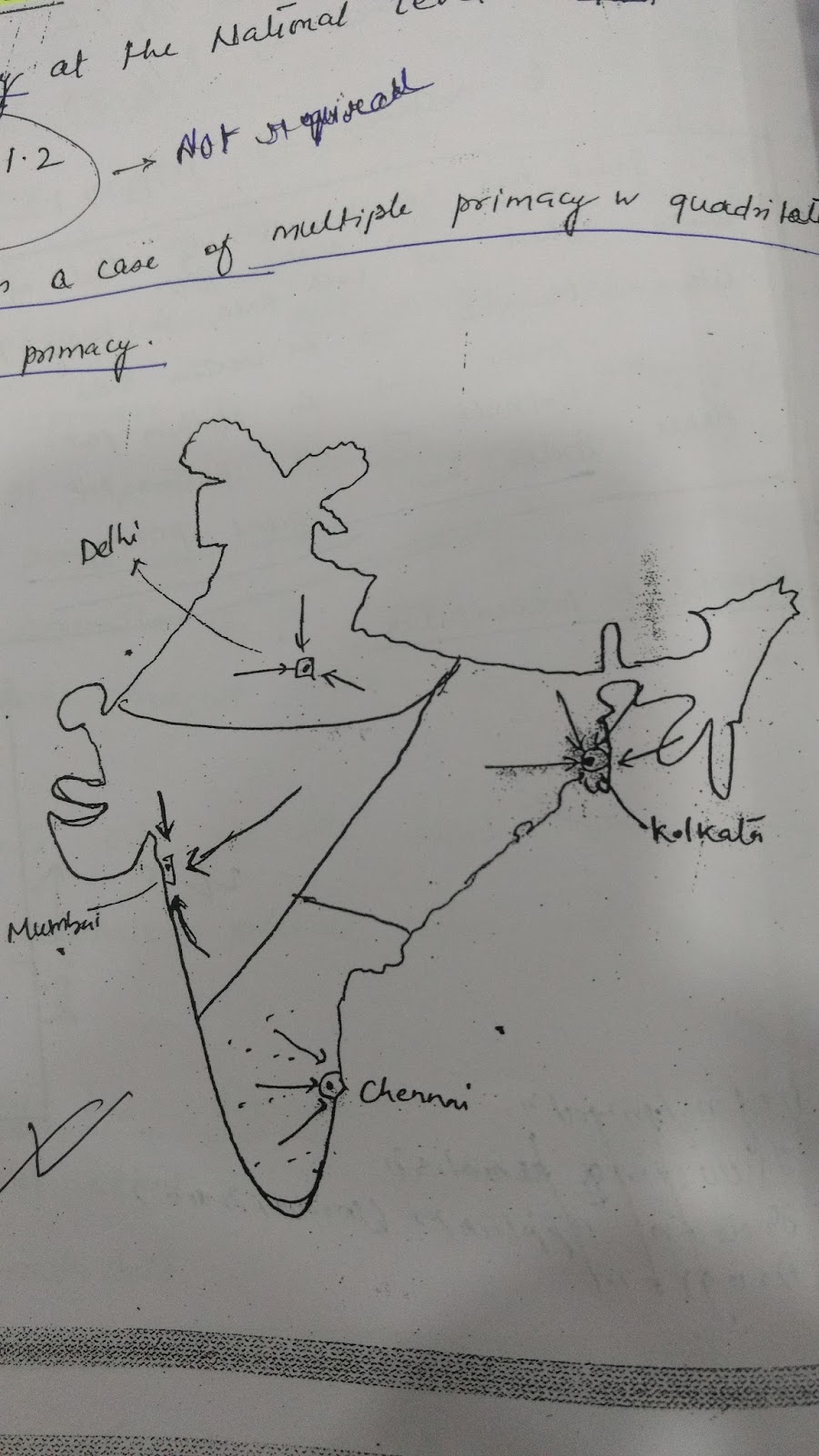
INDIA: No Primacy if country as a whole is considered.If divided into regions then primacy is witnessed i.e:

primate_city.jpg


  • MEXICO: P(Mexico city)/P(Cancun) > 17
  • URUGUAY: P(Montevideo)/P(Paysandu) > 17


Cause of Primacy
Mark Jefferson didn’t provide cause of primacy.Later, Gunnar Myrdal gave Cumulative causation theory which explains reason for primacy.
Linskey have provided criteria which leads to primacy.
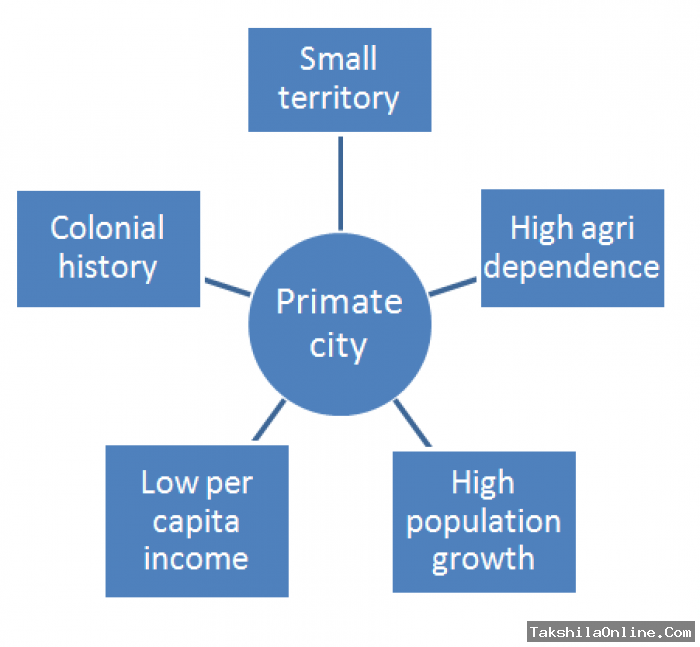
Through these criteria, Linskey seems to be concluding that primate city is developing country phenomenon.
However, not necessarily all developing countries exhibits primacy.For example, in india there is no primacy as delhi,chennai,mumbai,kolkata are comparable. This is because india has large territorial extent and great cultural diversity.One centre is not able to fulfill cultural,economic and historical aspirations of people.


Impact of Primacy
POSITIVE
In case of countries with smaller territorial extent, it is more desirable to concentrate resources and amenities to develop one urban complex that distributing resources with other cities.for example, UK and Malaysia
In case of un-developed countries, primate city is a desirable as it can serve as growth pole or centre for development.


NEGATIVE
Countries with large territorial extent can have negative impact of primate city as this can lead to disparity.for example, primacy of Sao Paulo in brazil has led to underdevelopment of other regions in brazil; Primacy of Moscow in russia as led to underdevelopment of siberia.

Comments

  1. is ur name abhishek ranjan singh from biet jodhpur

    ReplyDelete
  2. no yaar..... i am just Abhishek ranjan from Nalanda, Bihar.

    ReplyDelete

Post a Comment

Popular posts from this blog

DAVIES,PENCK & KING

Geographical Cycle of Davies William Morris Davies was an american geographer who gave first general theory on landform development.. Davis' most influential scientific contribution was the "geographical cycle",  which he defined in an article,’ The Rivers and Valleys of Pennsylvania ,’ published at the end of 19th century. According to him, uplifted landmass undergoes sequential development or erosion till base level in various stages.This sequential development referred as cycle of erosion. FUNDAMENTAL PRINCIPLES 1.Cyclic nature of landform evolution. 2 Uniformitarianism:The same physical processes and laws that operate today, operated throughout geologic time, although not necessarily always with the same intensity as now BASIC POSTULATES Upliftment takes place on featureless plain which he modified 10 yrs later to accept it can occur from geosyncline. Upliftment on geological timescale is sudden.In later works, he accepted it to be episodic. ...

Diving into the Depths of the Unconscious: A Comprehensive Exploration of Carl Jung's Red Book

Carl Gustav Jung's Red Book: Liber Novus is not just a book; it's an experience.  A sprawling, intensely personal, and visually stunning journey into the depths of Jung's psyche, it documents his confrontation with the unconscious and his exploration of the symbolic language of dreams and visions.  Far from a dry academic treatise, it's a vibrant tapestry of text and image, a testament to the power of the unconscious and its profound influence on the individual and collective human experience.  This exploration delves into the Red Book's genesis, its core themes, its unique format, and its lasting impact on our understanding of the self. The Genesis of the Red Book: A Descent into the Unconscious The Red Book's story begins in 1913, a period of intense personal and professional upheaval for Jung.  His break with Sigmund Freud, the founder of psychoanalysis, had left him feeling isolated and disoriented.  Haunted by vivid dreams and visions, Jung embarked on a jo...

Rene Descartes: A Critique

Introduction René Descartes (1596-1650) was a French philosopher, mathematician, and scientist who is considered one of the founders of modern Western philosophy. He is known for his contributions to analytic geometry, his development of the scientific method, and his famous philosophical statement "Cogito, ergo sum" ("I think, therefore I am"). Descartes is also known for his works on metaphysics, epistemology, and the philosophy of mind. Descartes' ideas had a significant impact on the development of Western philosophy and science. His emphasis on reason and mathematical reasoning as a tool for discovering truth has been influential in the development of the scientific method. Additionally, his ideas on the separation of mind and body and the nature of reality have continued to be influential in modern philosophy. Descartes' works include "Meditations on First Philosophy," "Discourse on the Method," and "Principles of P...